


Welcome to Polymathic Being, a place to explore counterintuitive insights across multiple domains. These essays explore common topics from different perspectives and disciplines to uncover unique insights and solutions.
Today's topic ignites the conversation about human hubris and its ecological impact when we view ourselves as masters of nature, or set apart from the consequences. It looks at the recent focus on wildfires and how they’re largely of our own creation, though, not through the reasons that are often provided.
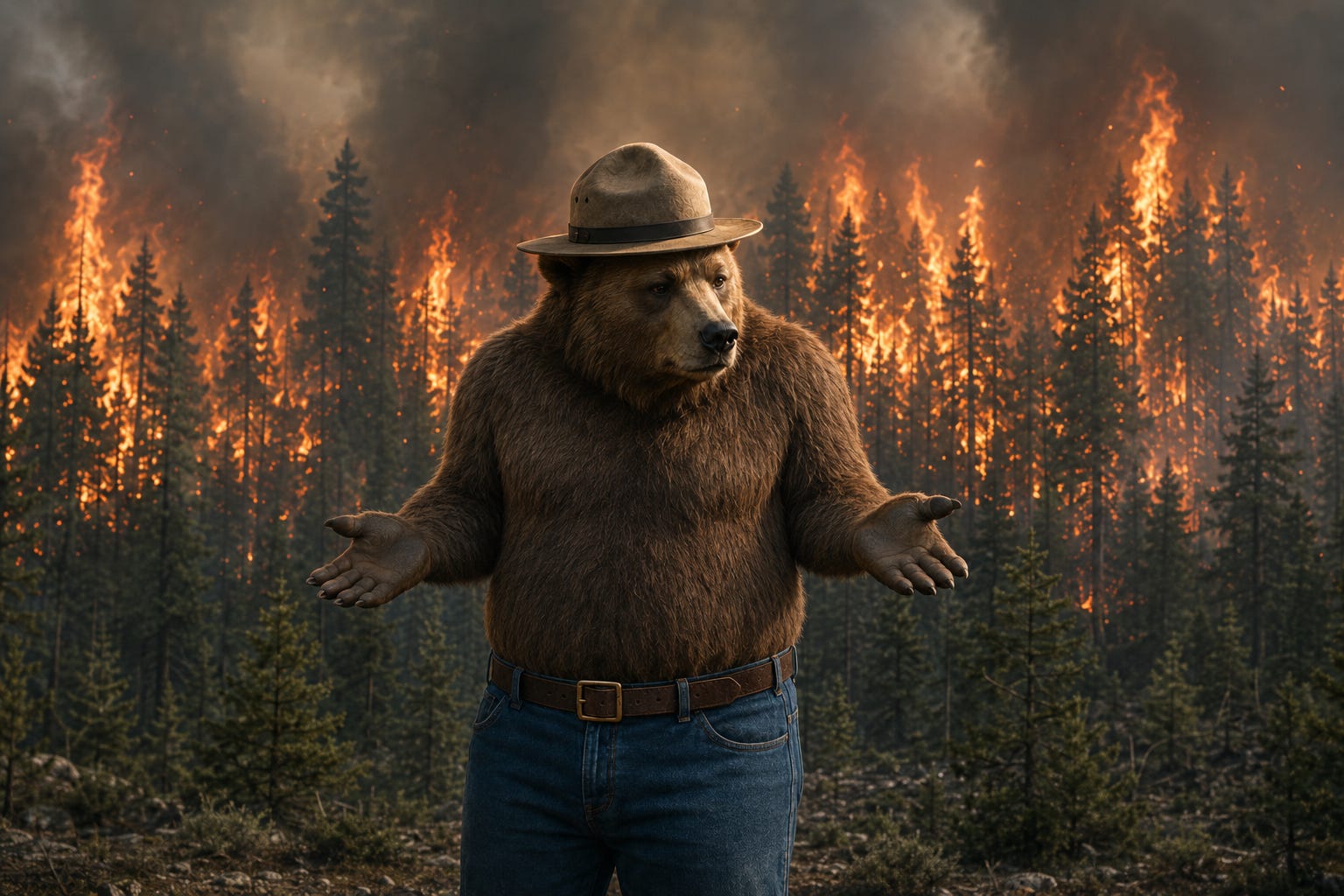
This summer, and most summers of the recent past, we are inundated with news of wildfires across Canada, California, and Europe. Last year started with the devastating wildfires in California and, for over two weeks, we watched the news as the entire town of Pacific Palisades burned to the ground. Everywhere we turn, it seems like the world is on fire.
The blame is often placed on climate change, but that’s only a minor part of the story. The main cause is actually the ecological disaster of Smokey Bear, the mascot for a well-intended prevention of human-caused wildfires, that rode on the back of suppression of ALL wildfires starting around 100 years ago.
Let’s start with a little context about fire first: It’s natural.
It’s so natural that everything on Earth has learned how to adapt to survive it. Even more so, fire is often an essential culling and reproduction method that keeps ecosystems healthy. For example, the Midwestern Jackpine requires fire in older forests to open the pine cones to allow new growth. When fires were suppressed, the stands of trees aged and choked out other species and ecosystems. Notably, the Kirtland Warbler was a bird on the verge of extinction until biologists recognized that it only nests in young-growth jackpine. Fire suppression was causing their extinction, and when prescribed burns were reintroduced, the population rebounded.
This is just one example of thousands, and so, for the sake of brevity, let’s look at what happens when we second-guess nature as we did following the Great Fire of 1910. This fire was undeniably catastrophic and shocked the world in its speed and devastation. It also led to the mass suppression of wildfires in the United States as the U.S. Forest Service shifted to a rigid policy of total fire suppression, aiming to extinguish every wildfire quickly and completely. This led to the 10 A.M. Policy in 1935, which mandated all fires to be suppressed by 10 a.m. the day after discovery.
The result was, counterintuitively, much worse fires. Extinguishing the fires early merely postponed the inevitable while allowing more fuel to accumulate. That’s because frequent low-intensity fires consumed grasses, fallen branches, and young trees, creating open forests in which larger, fire-adapted trees could survive.
Suppression overburdened the forests with unnaturally dense stands of trees connected by “ladder fuels” that can carry flames from the forest floor into the canopy. The resulting fires burn hotter, spread faster, and become far more difficult to control. Instead of fires that burned low and slow, the entire forest now burns.
A thousand years ago, especially in the US, those fires, even if catastrophic, had little human impact. However, dense housing developments nestled close to fuel-dense wildlands, and the resistance to allowing more suburban forests to burn and ‘scar’ the landscape views, created the perfect conflagration for an ecological disaster.
Simply put, what we are seeing is the result of fire suppression, which, even if climate change is putting a thumb on the scale, that scale is already overloaded with a hundred years of unnatural fuel that will burn, regardless.
Let’s focus on the Palisades Fire for a moment because the root causes of the ferocity and devastation were well known! In fact, Design For Disaster, a 1962 Documentary produced by the Los Angeles Fire Department, highlights how, long before we blamed everything on climate change, we understood the risks and yet spent the last 60 years doing nothing about it:
Central to this is the fundamental human foible of hubris. We just think we know more than we do; we tend to view ourselves as supernatural, and we tend to view completely natural things as problems to be contained. Put another way, instead of understanding nature, we pretend we are set apart and above that noise.
Three great examples start with what Chris Bray wrote in Culture of Failure, Geography of Reality, where he shares:
as you keep reading about Los Angeles being burned because of prolonged drought and a desperately dry landscape from climate change, notice what’s happening thirty miles to the south, as the beachfront City of Rancho Palos Verdes pumps up to a million gallons of groundwater a day into the ocean.
The second example is from Stan Luhr, a forensic building expert, who posted a great discussion on LinkedIn where he showed how the houses that burned down were designed in such a way that they are at high risk when you combine the high winds that are endemic to that area of California with fire, which is also a natural occurrence in that coastal desert.
High wind moves burning brands into attics.
Houses with vented (code required) attics burned down.
Houses with single pane windows burn down.
Houses with wood siding burn down.
The very few houses with no attic, no eaves, no gable vents and no combustible siding had the best chance for survival.
He goes on to say that, while water mains dried up due to the reservoir mismanagement, houses burned down with 50,000 gallons of water sitting in pools nearby. That’s the typical amount of water needed to fight a single-family home fire.
The third example is how Eucalyptus trees were planted en masse because they grow fast, they’re quite lovely, and they do well in the California coastal deserts which surround LA. Problem is, they are also nature's pyromaniacs with volatile oils that vaporize under heat and release flammable gases…
So, how many layers of hubris do we have?
Total fire suppression
Combined with restrictions to controlled burning due to concerns of CO2 emission and air quality
densely packed eucalyptus trees like gas-soaked rags
All wrapped into a coastal desert that gets less rain than the Sonoran Desert in Southern Arizona.
Add in the issue with the houses
Then water management
And this doesn’t even get into the problems with the fire response.
Oh, I need to add one more because in 2019, the Los Angeles Department of Water and Power (LADWP) began to replace century-old wooden power line poles with steel, widen fire-access lanes, and clear surrounding brush. However, environmental advocates halted the work within days out of concern for the endangered Braunton's milkvetch plants. However, those plants all burned to a crisp in 2025…
So, what do we do with this information?
For every heart-rending picture of burnt wildlife is the underlying reality that Nature isn’t nice; things do die. Fire kills.
Yet it’s also perfectly natural, and it really helps to appreciate nature in all its destructive glory.
It also helps to contextualize that, while Smokey Bear was a well-intended activity, our perpetual human hubris has turned it into an ecological disaster worse than anything Nature would have thrown at us without our interventions.
Thankfully, since it’s almost totally human-caused, we can actually fix it, and this starts with disabusing our pretention that we can control nature or that we can stand outside of it without consequence. Once we do that, we can start to better understand our integration with Nature:
Better forest management through intentional burns
This has been starting, but with so much fuel accumulated, this is an incredibly difficult challenge without tremendous labor or the acceptance of more catastrophic fires.
Intelligent building codes:
Back to Stan from above, that great discussion on LinkedIn comes with a lot of good building ideas like installing pipes into pools that fire trucks can connect to, spraying fire retardant in attics, water sprinklers in eaves, and more.
Improved urban/wild integration:
Ensuring proper set aside for wild areas, and when combined with #1, the acceptance that fire scars are a healthy sign for regrowth.
Understanding the larger impact of housing in fire-prone regions.
Recognizing the multi-level role of water management and use
And there are even some fun ideas like the introduction of goat herds, on public and private lands, to help reduce foliage. A partnership where ranching can become integrated in urban areas, as Smithsonian Magazine discusses here.
Finally, just to foot-stomp this: Humans are natural, and we are hubristic. We really have to understand that we cannot control nature because, despite our best efforts, nature finds a way to humble us.
What I find, when I apply this to my own life, is more understanding of how I fit in the world, a greater sense of calm about catastrophe, a greater connection with nature, and more humility and appreciation for the world around me. Smokey Bear may have been an ecological disaster, but it provides an opportunity for us to understand who we are and how we fit into a more natural existence.

Did you enjoy this post? If so, please hit the ❤️ button above or below. This will help more people discover Substacks like this one, which is great. Also, please share here or in your network to help us grow.
Polymathic Being is a reader-supported publication. Becoming a paid member keeps these essays open for everyone. Hurry and grab 20% off an annual subscription. That’s $24 a year or $2 a month. It’s just 50¢ an essay and makes a big difference.
Further Reading from Authors I Appreciate
I highly recommend the following Substacks for their great content and complementary explorations of topics that Polymathic Being shares.
Goatfury Writes All-around great daily essays
Never Stop Learning Insightful Life Tips and Tricks
Cyborgs Writing Highly useful insights into using AI for writing
Educating AI Integrating AI into education
Socratic State of Mind Powerful insights into the philosophy of agency
I graduated college with a degree in forest management back in the early 90's. Nothing has changed since then. All that you point out here is true now and was known then. From my perspective it is a problem of rapid development disrupting established routines of management. National forests that have maintained their established routines do well enough. But, areas where public opinion and political pressure disrupt established management routines do exactly as you say. One such example is the I-70 corridor in Colorado. No one wants to see the timber harvest, or the scorch of prescribed fire. Unfortunately, my cynicism holds that there is no way to solve this problem as our current culture favors short term gratification over long term stability. And fire cycles are certainly a long term management issue.
Another insightful gem, along with a new vocabulary word from the LinkedIn piece: "intumescent"
I agree with all of this, except I don't know how Rancho Palos Verdes could find an efficient use for the groundwater they are expelling into the ocean for, according to them, mitigating landslides. It takes considerable time and effort [at tremendous cost if not a long-term solution to a continual problem] to redirect groundwater away from where it happens to be to where it might be used, as is also the issue with stormwater collection.
Also found it noteworthy for a long time that wealthy "environmentalists" enjoy living in the woods or in boreal borderlands, which require significant disturbance to build their "natural" habitats. But such is human hubris. However, there's another problem in modern American society, which is hard to talk about honestly.
Something like this has no apparent logic behind it, unless they want to encourage wildfires:
https://www.youtube.com/watch?v=NLAFyuVS49s
Neither does the political dysfunction in the LA fire department, or this uncomfortable fact:
https://abc7.com/post/fire-victims-frustrated-santa-ynez-reservoir-was-empty-during-palisades-is-dry/18956367/
Isn't it remarkable how the people who are always yammering about climate change don't ever seem to do anything to deal with it effectively? Assuming that's their actual goal. Or perhaps the goal is merely getting rich from "raising awareness" of a problem that is never solved.
The Dad Saves America podcast, along with Reason magazine, takes the libertarian view favoring fatal hubris, best summarized by the idea that "If socialists understood economics, they wouldn't be socialists." But that's a much more charitable interpretation than the notion that perhaps they don't care about economics, just as the CCP doesn't really care about the Chinese economy, as long as the party members can live well. Watching the behavioral cues of Gavin Newsom & Karen Bass immediately after the LA fires gave me the distinct impression of barely contained glee. Like watching Mamdani with his smug little smirk as he wrecks New York's economy, while the senior "responsible" Democrat governor forces out her state's financial supporters with similar policies.
Game of Thrones was a more honest reckoning of human nature than anything pundits observe today. Yes, Virginia, some people are psychopaths who really do want to see the world burn. And they get elected by people who don't understand the economic reality of tradeoffs. People who were educated by teachers who can never understand why pro athletes make more money than they do, because they have no business experience--and therefore don't see human nature in all its disturbing complexity.
I wish I could say that conservatives are going to save us, but that's not entirely true either. I'm not expecting Janice Quinones, the woman who emptied the Palisades reservoir for an entire year because of a torn fabric covering [on a reservoir meant for fire control]. Because our govt is a Democrat supermajority, and she's one of them. But I was expecting Alejandro Mayorkas, the one person who could explain the open-border policy during the Biden years, to be called before Congress the way Fauci was some time in the past year and a half. That, oddly, hasn't happened. Just as a handful of Republicans are doing their best to block voter ID laws, but won't say why.
We're in a lot more trouble than most of us realize, because we cannot look at our own society through the eyes of George R. R. Martin. But just look around the entirety of the Western world, and the madness of mass migration, disastrous energy policies, and toxic identity politics. It's a Machiavellian playbook for self-destruction, copied with inexplicable enthusiasm by nearly every Western liberal democracy--and the worse the consequences, the more vigorously they double down on the same insanity.
But all these problems are soluble if a plurality of the public is willing to temporarily shed some of our comforting delusions about human nature. Which happened after WWII; many important books were written about how and why entire nations chose to embrace evil. There were also a few great works written by refugees of communism. But unfortunately, it turns out there is little public appetite for such inquiry after a few years have passed. Much easier to put blame on evil men in dusty old books [preferably in foreign countries] than to stare deeply into the abyss on an otherwise sunny day.